
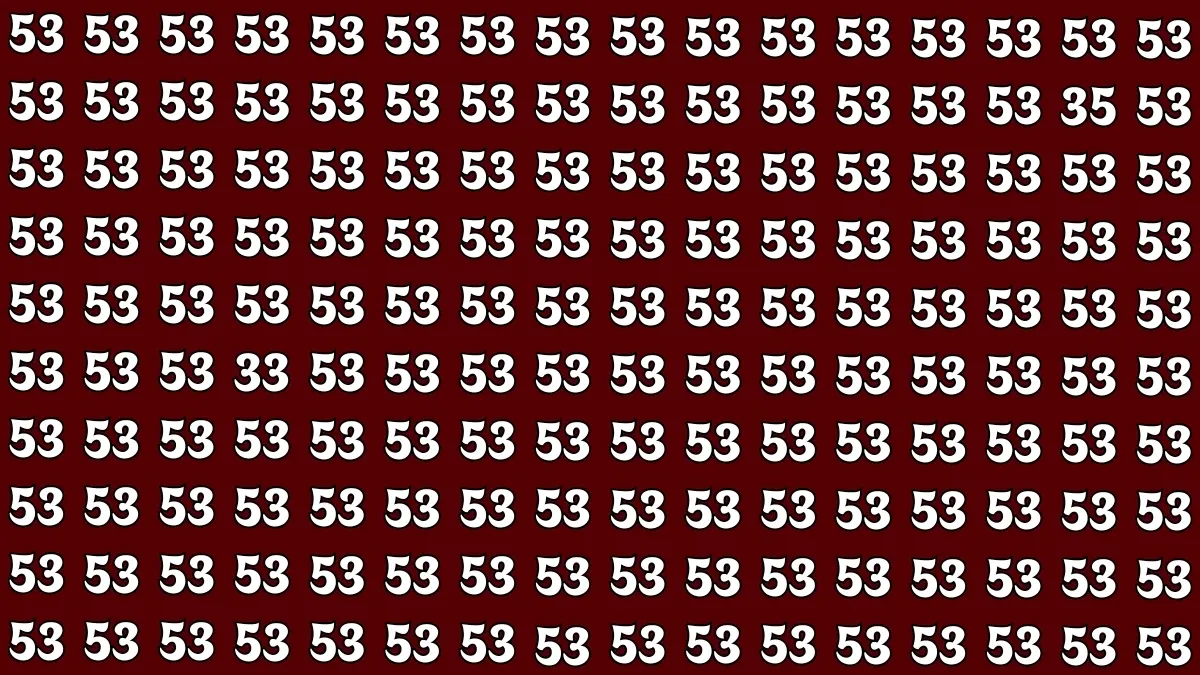
Optical illusions are fascinating visual tricks that challenge the way our brain perceives images. They create a gap between what our eyes see and what our brain interprets, making us question reality for a brief moment. This happens because the brain processes patterns, shapes, and contrasts faster than it processes fine details, leading to misinterpretations. These illusions can manipulate perspective, color, or symmetry to make us see things that aren’t really there—or to hide things in plain sight. One such challenge is making waves online: finding the hidden numbers 33 and 35 among a grid full of 53s within just six seconds.
Why Optical Illusions Fascinate the Human Mind
Our brains are wired to look for order and patterns. When we see repetitive visuals like the number “53” repeated across a grid, our mind starts recognizing it as a single pattern rather than individual digits. Optical illusions play on this mental shortcut. They exploit how our visual system prioritizes speed over accuracy. The challenge of spotting a small variation, like “33” or “35,” within dozens of nearly identical figures forces the brain to slow down and observe carefully. This creates a tug-of-war between perception and reality, making the experience both confusing and entertaining.
The Challenge: Find 33 and 35 Among the 53s
At first glance, the grid seems uniform just rows and columns of the number “53.” The brain immediately assumes all numbers are the same, so it filters out minor variations. But hidden within this pattern are two different numbers: 33 and 35. The challenge is to spot them both in under six seconds. It sounds simple, but once you start scanning, the numbers begin to blur together, creating visual noise that tests your patience and focus.
The key to mastering this illusion lies in how you scan the image. Instead of looking at the grid as a whole, narrow your focus to smaller sections. Move your eyes slowly across each line rather than jumping around randomly. When your brain adjusts to the rhythm, it becomes easier to detect slight differences in shape and spacing.
How the Brain Gets Tricked
Optical illusions like this one rely on the phenomenon known as pattern recognition fatigue. When the eyes see a repeating pattern for an extended time, the neurons responsible for detecting differences start to relax. As a result, your visual system becomes desensitized, making it harder to notice subtle variations. That’s why even though “33” and “35” are visibly different from “53,” your brain might overlook them at first.

Another factor is similarity masking. Since all digits share similar shapes—especially the curved “3” and the straight “5” our visual system groups them together as identical. This is why illusions based on repetitive numbers or letters are so effective at hiding differences.
Tips to Solve This Challenge Quickly
If you want to train your eyes to find the hidden numbers faster, try these strategies:
- Focus on symmetry: The number “33” has repeating curves, while “53” combines a straight and curved shape. Scanning for this difference helps spot the “33” quickly.
- Look for spacing: Sometimes, hidden numbers are slightly misaligned. Noticing irregular spacing in the pattern can lead you to the target.
- Use your peripheral vision: While scanning, your side vision might catch something that feels “off.” Follow that instinct it often points you toward the hidden element.
- Take a short visual break: Looking away for a second resets your pattern recognition, allowing your eyes to spot differences more easily when you refocus.
The Solution: Where Are 33 and 35 Hidden?
If you’ve tried and still can’t find them, here’s where to look. The number 33 is positioned near the center of the grid, specifically in the sixth row and fourth column from the left. It breaks the repetitive pattern subtly but noticeably once you focus on that area. The number 35 is tucked away toward the top right section of the image, in the second row from the top and second column from the right. Once you locate these two numbers, you’ll wonder how you missed them before.
Both numbers are cleverly placed to blend into their surroundings, making them almost invisible at first glance. But after identifying them, your brain automatically “locks in” on their shape, and they suddenly seem obvious. This switch from confusion to clarity is what makes optical illusions so rewarding.
The Science Behind the Fun
Challenges like this one aren’t just amusing—they also strengthen cognitive skills. Studies suggest that visual puzzles and optical illusions improve attention span, memory recall, and pattern recognition. When you try to spot differences in repetitive visuals, your brain is forced to slow down and analyze information more deeply. This enhances focus and visual discrimination over time.

Moreover, these illusions engage both sides of the brain—the left (responsible for logic and detail) and the right (associated with creativity and spatial understanding). That’s why they appeal to people of all ages they combine entertainment with subtle mental exercise.
Final Thoughts
Spotting the numbers 33 and 35 among 53s may seem like a lighthearted challenge, but it reveals a lot about how our perception works. It shows that what we see isn’t always accurate—our minds often fill in gaps or overlook details when overwhelmed by repetition. The next time you come across a similar puzzle, remember that patience, focus, and a bit of curiosity are all you need to win.
Optical illusions like this one remind us that our brains are powerful but far from perfect. They teach us to slow down, observe carefully, and question what we see. And once you’ve mastered this challenge, try sharing it with friends after all, a little friendly competition can make spotting hidden details even more fun